Home Organizer vs Deep Cleaning — Which First?
Clutter vs dirt — different problems, different services. The 'organize first, then deep clean' rule. Combined-service scenarios and pricing.
Published May 9, 2026
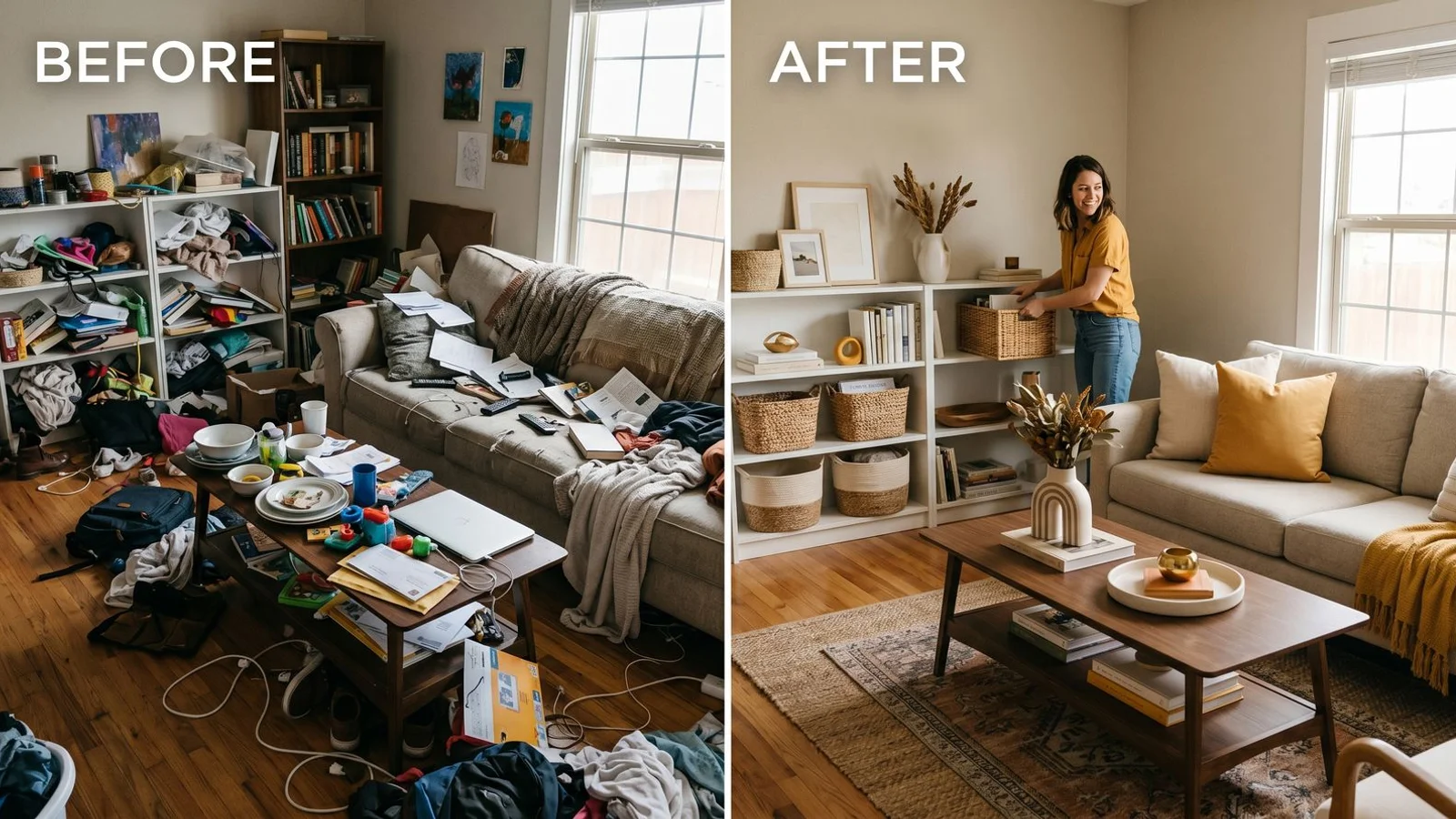
We see this confusion all the time in the residential cleaning industry.
Homeowners often book a standard maid visit when their actual hurdle is a surplus of misplaced possessions. A 2025 survey from the Professional Organizer Institute found that 54% of Americans feel overwhelmed by household clutter.
Our teams regularly encounter spaces where cleaning is physically impossible until someone addresses the underlying disorganization. You need to know exactly which issue dominates your living space before hiring help.
This guide breaks down the core choice of a home organizer vs deep cleaning, along with the most cost-effective sequence for tackling both.
This guide expands on what we cover in our full home organization service; use it as the deep-dive companion to that page.
Clutter vs dirt, the actual distinction
We define clutter as stuff simply resting in the wrong place. Mail piles up on the kitchen island. Clean laundry covers a bedroom chair.
- Toys scattered far outside their designated bins.
- Closets stuffed with garments you never wear.
- Pantries holding food past its expiration date.
- The garage half-swallowed by sports equipment from three summers ago.
Our experts know that the primary problem here is organization. The National Association of Productivity and Organizing Professionals (NAPO) reports that a staggering 80% of items in typical homes remain unused. Dusting around the chaos does not fix the root issue.
We recommend sorting the space and building a dedicated storage system first. Routine maintenance then keeps that system functional. Removing excess belongings actually eliminates 40% of average housework, according to data from the National Soap and Detergent Association.
Our teams emphasize that decluttering vs cleaning requires a completely different strategy. Dirt is the physical buildup of grime on your surfaces. You might notice a greasy residue coating the stovetop or dust settling heavily on baseboards.
- Hard-water spots permanently clouding the shower glass.
- Pet hair embedded deep into couch cushions.
- Cedar pollen covering horizontal surfaces during allergy season.
- Bathroom grout turning several shades darker than its original color.
We find that organizing the bathroom vanity does not address moldy grout lines. The grout requires chemical treatment and heavy scrubbing. Most households struggle with some combination of both problems, so identifying which issue dominates dictates your starting point.
Indicators you need organization first
We suggest hiring an organizer if physical items prevent you from using your space for its intended purpose. A 2025 report from the Professional Organizer Institute shows the average person spends 2.5 days per year looking for misplaced items due to disorganization. You might simply forget what you already own.
Our professionals recommend starting with organization if you constantly say you cannot find anything.
- Closet doors refuse to close completely.
- The pantry has a distinct layer of expired food.
- Cars cannot park inside the garage.
- Office paperwork piles up on multiple flat surfaces.
- Children’s rooms feature a massive sprawl of toys.
- Unpacked boxes remain long after a recent move.
- Kids’ rooms sit full of unused stuff after an empty-nest transition.
- Kitchen contents need a temporary home after a renovation.
Organization is the clear first step if those scenarios describe your current living space. The process instantly recovers usable square footage.
Indicators you need deep cleaning first
We tell clients to book a deep cleaning if surface buildup is the primary obstacle. According to 2026 data from Thumbtack, heavy grime on baseboards and in tile grout requires intense scrubbing that goes far beyond basic tidying. A home fits this profile if the last professional cleaning occurred more than six months ago.
Our crews look for specific environmental signs that indicate a property needs a thorough scrub down.
- Visible dust coats baseboards or rests above eye level.
- Kitchen surfaces feel sticky or greasy to the touch.
- Bathroom grout appears noticeably darker than the surrounding tile.
- Cedar pollen season triggers severe indoor allergies.
- A strong pet odor hits you right when you walk inside.
- The house needs prep before listing for real estate.
- You are preparing for major holiday hosting.
Booking a deep clean makes sense when these specific conditions dominate the home. This heavy scrub establishes a hygienic baseline.
The “organize first, then deep clean” rule
We always enforce the mandate to organize before deep clean for households dealing with both challenges. Thumbtack’s 2026 pricing index shows that hourly labor for deep cleaning runs between $50 and $120 for a two-person team. Paying those rates to have cleaners move boxes around is highly inefficient.
Our company structures services this way for four critical reasons. This sequence guarantees the best return on your investment.
- Cleaning around clutter wastes time. Most of the cleaning visit gets spent shifting objects rather than scrubbing surfaces. The team never reaches the actual dirt trapped under the piles.
- Organization reveals hidden grime. Surfaces obscured by clutter often hide heavy buildup the household completely forgot about. Pulling those items out exposes the actual scope of the required scrubbing.
- We notice that cleanliness lasts longer in structured homes. When every item has a designated place, surfaces stay clean much longer between visits. Daily life naturally puts things back rather than letting random drift accumulate.
- Sequenced visits reduce total costs. The total price drops significantly compared to an ad-hoc, same-day combined scramble.
Combined-service scenarios
We see specific milestones that almost always require a multi-step approach. The sequential pattern fits several major life transitions perfectly. These events disrupt normal household routines.
Moving and Renovations
Our move-in cleaning teams face a unique challenge with previously occupied homes. Even if the previous owner left a spotless house, your personal belongings arrive in chaotic boxes. April 2026 data from Angi indicates that a dedicated move-out or move-in clean averages $360, making it a distinct investment from unpacking labor.
We advise you to organize as you unpack the boxes, and then deep clean once the cardboard dust settles. Post-renovation projects follow a similar logic. A kitchen rebuild leaves your cookware and appliances homeless during the construction phase.
Our best practice is to re-organize the kitchen cabinets first, then tackle the fine drywall dust. You must establish the new storage zones before polishing the counters.
Life Transitions and Real Estate
We frequently help clients manage empty-nest transitions that create newly available space. Adult children leaving home leaves behind rooms that require heavy decluttering before any recurring service can maintain them. Pre-listing preparation demands a very strict sequence.
Our staging partners confirm you need to depersonalize the property first, followed by a heavy scrub. The National Association of Realtors’ 2025 Profile of Home Staging reports that staging a home increases the final offer value by 1% to 10%. Staged homes also spend 73% less time on the market.
We highly recommend sequential services for recovery from a demanding phase of life. Having a first child, adopting a new pet, or dealing with family illness pushes home maintenance aside. Professional intervention provides the necessary reset to get back on track.
Pricing differences
We want you to understand the financial breakdown so you can budget accurately. March 2026 data from Angi shows that the national average for deep cleaning a house is $260. The exact price heavily depends on your specific square footage.
Our pricing models separate the two services because they require entirely different skill sets. Organization labor scales hourly based on the volume of belongings, while cleaning is a flat rate based on the property size.
| Service Type | Typical Pricing | Average Timeframe |
|---|---|---|
| Organization | $75 to $100 per hour per organizer | 3 to 6 hours for a single closet; 3 to 5 days for a whole home |
| Deep Cleaning | $250 to $600 flat rate (3-bedroom home) | 4 to 8 hours depending on condition |
| Combined Approach | $700 to $1,500 total (3-bedroom home) | Split across 2 to 3 separate days |
Doing only the organization leaves the underlying grime completely unaddressed. Our experience shows the math usually favors the combined approach when both problems exist in a single home. Paying for a deep clean alone in a cluttered house runs higher due to the sheer inefficiency of moving objects.
Combined service scheduling
We do not run organization and cleaning teams simultaneously. The two disciplines operate on different rhythms and require different physical space. Following this timeline ensures the best final result.
Our standard pattern creates a built-in testing phase for the client.
- Day 1: Organization session lasting 3 to 8 hours.
- Day 1 evening or Day 2: The settle period. The household uses the newly organized space briefly to validate the storage system.
- Day 2 or 3: The deep cleaning visit takes place.
- Optional Day 4+: Recurring biweekly standard cleaning officially starts.
We find that the brief settle period matters immensely. Sometimes a small adjustment to the storage bins is needed before the scrubbing team arrives. The household must live in the space briefly to make sure the flow makes sense.
For organization process details, see how professional home organization works.
For deep cleaning scope, see what’s included in a deep cleaning.
Visit our site to Get a quote. Tell the team which problem dominates your home right now, and someone will recommend the right starting service.
Related service
Need Organization in San Antonio?
Decluttering, organizing, and minor concierge tasks. Pairs perfectly with deep cleaning when stuff has built up.