Carpet Cleaning Methods Explained
Hot water extraction (steam), dry/low-moisture, encapsulation, bonnet — tradeoffs in dry time, deep-soil removal, fiber risk.
Published May 9, 2026
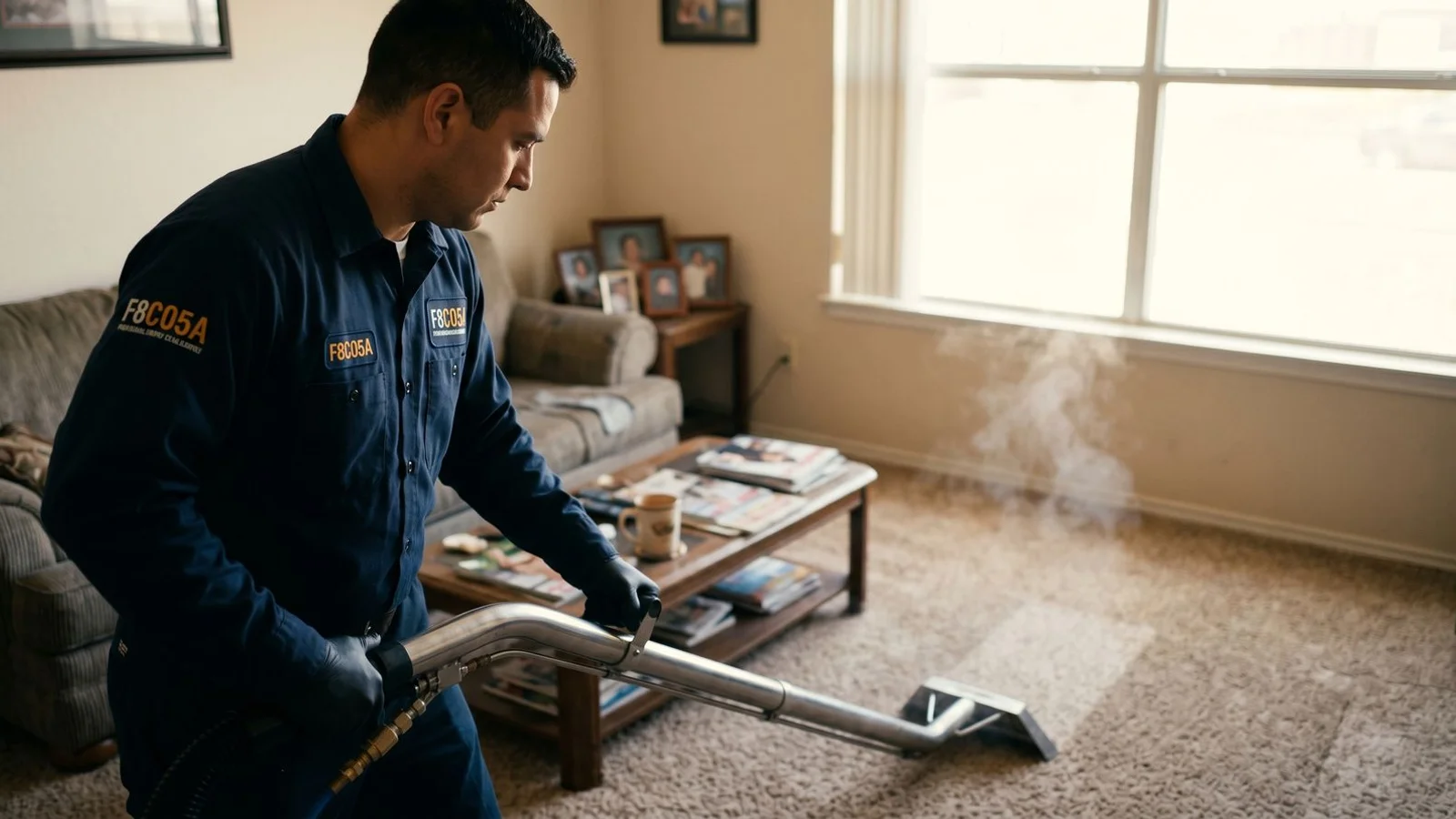
Different carpets and different soil loads call for different carpet cleaning methods. Most homeowners rarely think about floor care until a stubborn spot appears or a lease comes to an end.
Our daily schedule at San Antonio Maid Services shows exactly what happens when maintenance is delayed. Dirt acts like tiny razor blades against the fibers, causing permanent traffic patterns that no machine can reverse.
We know that picking the wrong treatment approach can permanently ruin expensive flooring.
A rental machine and a truck-mounted commercial unit will give completely different results on the exact same surface.
Let’s break down the exact methods available, examine the chemistry behind each option, and outline how to choose the right process for your home.
This guide expands on what we cover in our full carpet and upholstery cleaning service; use it as the deep-dive companion to that page.
Hot water extraction (steam carpet cleaning)
Hot water extraction is the deepest carpet cleaning method available for residential use. High-temperature water between 180 and 200 degrees Fahrenheit is injected into the flooring under pressure to agitate embedded soil, and then it is immediately extracted under vacuum. Both the pad and the fiber get thoroughly cleaned.
The Carpet and Rug Institute, along with major manufacturers like Shaw and Mohawk, require this specific procedure every 12 to 18 months. Skipping this scheduled service will automatically void most modern flooring warranties. Our technicians verify the manufacturer guidelines before applying high heat. Extreme temperatures can cause older, unstable installations to buckle or shrink.
| Season | Average San Antonio Humidity | Estimated Dry Time |
|---|---|---|
| Summer | High (Up to 87 percent in mornings) | 6 to 8+ hours |
| Winter & Spring | Moderate (60 to 70 percent) | 4 to 6 hours |
Best for:
- First-time deep cleans
- Pet households dealing with urine and dander
- Allergy-sensitive households needing dust mite removal
- Heavy soil loads in primary living spaces
- Annual or biannual warranty maintenance
Tradeoffs:
- Dry time: Typical wait is 4 to 8 hours.
- Equipment cost: Truck-mounted commercial units extract much more deeply than portable units.
- Fiber risk: Wool and antique textiles need temperature-controlled extraction.
Our local San Antonio weather directly affects the drying process. Summer morning humidity routinely peaks at 87 percent in this region. This dense moisture extends the evaporation window significantly. We recommend running the air conditioning, opening interior doors to improve airflow, and setting up floor fans immediately after the service.
Low-moisture (encapsulation carpet cleaning)
Encapsulation carpet cleaning applies a specialized crystallizing polymer solution directly to the floor using a rotary brush. This cleaning agent surrounds dirt particles and hardens them into dry crystals overnight, allowing you to easily vacuum the debris away the next morning.
Professional commercial brands like Releasit or Cimex formulate their polymers to leave zero sticky residue behind. Many cheap grocery store spot cleaners leave a soapy film that acts like a dirt magnet. Our team appreciates how fast this low-moisture chemistry works in large spaces. A single gallon of commercial encapsulation fluid can treat up to 15,000 square feet of office flooring.
Best for:
- Time-pressured situations like apartment turn-overs
- High-traffic refreshes between annual deep cleans
- Commercial-style glued-down applications
- Fibers that cannot tolerate over-wetting
- Minor soil loads on otherwise clean flooring
Tradeoffs:
- Dry time: Carpets are typically dry in 2 to 4 hours.
- Cleaning depth: The chemistry handles surface and shallow dirt, but it does not reach the pad.
- Repeat frequency: Spaces require this service more frequently than steam treatments.
This technique serves as an excellent maintenance tool between major extractions, but it is not a complete replacement. The shallow cleaning depth simply does not reach deep-seated contamination near the subfloor.
Bonnet cleaning
Bonnet cleaning uses a spinning floor machine equipped with a heavy absorbent pad to wipe dirt from the top layer of the carpet. This provides a very fast, surface-level clean that works well for thin, commercial textiles.
The rotary machine spins the pad at roughly 175 revolutions per minute to generate heat and friction. Our specialists rarely use this aggressive technique in residential settings. The intense friction can easily damage softer residential fibers, causing them to fray and untwist prematurely.
Best for:
- Commercial settings like large offices or hotels
- Quick aesthetic refreshes of high-traffic commercial hallways
- Specific low-pile synthetic materials
Tradeoffs:
- Cleaning depth: The pad only wipes the top layer and completely misses embedded soil.
- Fiber abrasion: The spinning action can permanently damage plush household carpets.
- Frequency: This is a short-term cosmetic fix, requiring the most frequent visits.
We reserve bonnet tools exclusively for partial refreshes on synthetic commercial carpets. It pushes dirt downward rather than pulling it out, making it ineffective for deep restoration.
Dry compound cleaning
Dry carpet cleaning brushes a moisture-free absorbent compound directly into the carpet pile to soak up dirt and oils. The soiled powder is then extracted using a heavy-duty commercial vacuum.
Professional dry compounds function like millions of tiny micro-sponges. We recommend this strictly for specialty natural materials that will be ruined by water. Plant-based textiles react very poorly to traditional wet extraction.
Best for:
- Carpets that absolutely cannot tolerate any moisture
- Quick spot treatments in busy lobbies
- Areas where zero down-time is required
Tradeoffs:
- Cleaning depth: The powder provides a very light, surface-only result.
- Use cases: The application is highly narrow and generally ineffective on mud or grease.
Our crews utilize dry compound methods infrequently. It is reserved almost exclusively for high-end area rugs or client moisture restrictions that rule out every other option.
Method selection by fiber type
Different fibers require entirely different approaches to prevent shrinkage, melting, or color loss.
Synthetic Fibers
Modern synthetic carpets dominate the residential market due to their durability and low manufacturing cost.
- Nylon: This is the most common and resilient synthetic fiber available. It tolerates high heat perfectly, and a thorough steam treatment will actually restore its original twisted structure.
- Polyester: This material holds color beautifully and responds well to hot water extraction. Our technicians avoid extreme heat on polyester to prevent the plastic fibers from melting.
- Olefin (Polypropylene): This plastic-based fiber resists water-based stains incredibly well. It attracts oil like a magnet, however, requiring specialized degreasing pre-sprays before extraction.
Natural Fibers and Specialty Loops
Natural materials and complex weaves demand a careful, customized approach to avoid permanent structural damage.
- Wool: High heat shrinks wool fibers aggressively, and alkaline chemistry strips away their natural protective oils. We perform a pre-test on all wool pieces and use strictly temperature-controlled extraction or dry compound methods.
- Berber: The dense loop construction of Berber carpet hides wear well but traps heavy soil deep against the backing. Steam is heavily preferred here to flush out the debris trapped at the base of the loops.
- Sisal, Jute, and Natural Fiber: These plant-based materials must avoid moisture entirely. Even a small splash of water causes immediate shrinkage and permanent brown watermarks. Dry compound cleaning is the only safe option.
Our initial walkthrough always includes a detailed fiber assessment before a single machine is turned on. Most San Antonio residential floors feature nylon or polyester, making them ideal candidates for standard deep extraction.
Pet stain and odor handling
Surface-level cleaning fails completely on pet stains because the urine contamination penetrates the carpet pad and reaches the subfloor below. Pet households require a targeted sub-surface approach to break down the underlying uric acid crystals.
Enzyme treatments are the only scientifically proven way to digest organic waste permanently. Our protocol requires applying these biological cleaners and allowing them adequate dwell time to eat away the odor-causing bacteria. Standard soaps simply mask the smell for a few days until the humidity rises again.
For pet households, the typical procedure involves:
- Pre-treating pet zones with a professional enzyme solution.
- Allowing the product a full 24 to 48 hours to break down the organics at a molecular level.
- Flushing the area using high-temperature water extraction.
- Providing an honest assessment of subfloor damage, as severe cases may require full pad replacement.
See pet stain and odor removal from carpets for a comprehensive breakdown of this specialized service.
Combining with other services
Bundling your floor care with a whole-house reset saves money and ensures the property is cleaned in the correct chronological order. We always schedule the heavy floor equipment as the final step after all upper-level dust is cleared away.
Construction zones and major renovations leave microscopic drywall dust embedded deeply in the carpet fibers. Our crews must perform an extensive dry HEPA vacuuming session before introducing any water. Wetting fine construction dust immediately turns it into a hard mud paste that is nearly impossible to extract.
Floor maintenance bundles perfectly with these standard offerings:
- Move-out cleaning: Many apartment leases legally require a professional truck-mounted service receipt to refund your security deposit.
- Deep cleaning: This provides a total top-to-bottom reset for a new home.
- Post-construction cleaning: This safely removes hazardous building materials and fine particulate matter before you move furniture in.
Standalone floor appointments run $35 to $75 per room. We offer a 10 to 15 percent discount on combined service packages compared to booking separate visits.
Pricing factors
Standalone cleaning costs are generally straightforward, but several unique variables will impact your final quote. The size of the space, the presence of stairs, and the condition of the flooring directly dictate the required labor and chemistry.
The national average cost to replace carpet in 2026 runs between $3 and $6 per square foot. Our data shows that replacing a standard 330-square-foot living room can easily exceed $1,500. Routine professional maintenance is a highly cost-effective investment that extends the lifespan of your flooring by years.
Beyond the selected treatment method, these elements affect your total price:
- Number of rooms: Bedrooms, hallways, and living spaces are each priced individually.
- Stairs: Vertical spaces require specialized hand tools and are priced per flight or as a half-room.
- Carpet condition: Heavy soil loads or widespread pet contamination require significantly more time and expensive enzymatic chemistry.
- Specialty fiber: Delicate materials like wool or sisal command a premium for the required specialty handling.
- Furniture moving: Light moving is generally included, but extremely heavy or fragile pieces incur an extra fee.
For strategic advice on scheduling, see how often should carpets be cleaned.
Get a carpet cleaning quote today to protect your investment. Our experts will assess your home and recommend the exact right method based on your specific fiber type and condition.
Related service
Need Carpet & Upholstery in San Antonio?
Steam, low-moisture, and encapsulation methods for carpets, rugs, and fabric furniture. Stain removal and pet-odor treatment that actually lasts.