Post-Construction vs Deep Cleaning — Which Fits?
Tooling differences (HEPA, contractor bags), scope differences (debris handling), when to schedule deep clean AFTER post-construction, pricing.
Published May 9, 2026
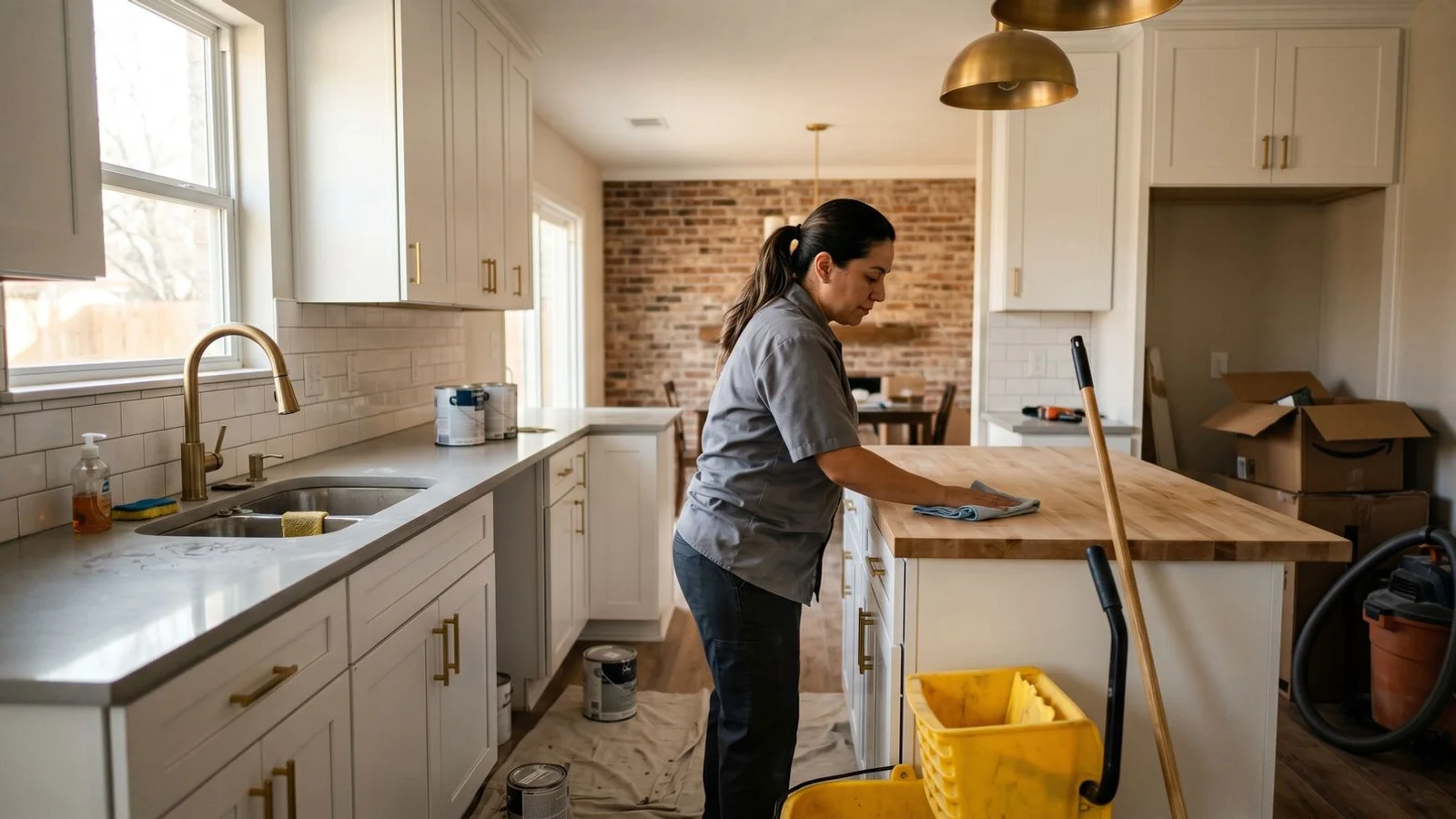
From what I have seen as part of the San Antonio Maid Services team, the choice between post construction cleaning vs deep cleaning trips up nearly every homeowner. You just finished a messy renovation and want your space back.
We regularly see clients guess wrong on the service they need.
“Making the wrong choice leaves fine drywall dust circulating through residential HVAC systems for months, dropping indoor air quality far below healthy limits.”
According to a 2025 Environmental Protection Agency report, indoor air pollutants are often two to five times higher than outdoor levels. Construction dust makes this situation significantly worse.
Our crews handle this exact problem daily across the US. Let’s look at the actual differences between these two services and explore a few practical ways to schedule them correctly.
This guide expands on what we cover in our full post-construction cleaning service; use it as the deep-dive companion to that page.
Tooling differences: post construction cleaning vs deep cleaning
Post-construction cleaning relies on heavy-duty, OSHA-compliant extraction tools to capture hazardous building materials, while deep cleaning uses standard household equipment for everyday dirt. You cannot use a regular vacuum for contractor dust without risking motor burnout or blowing fine particles back into the air.
Our technicians use specialized gear built specifically for hazard containment. To ensure safety, they follow the OSHA 29 CFR 1926.1153 standard to keep respirable crystalline silica exposure well below the 50 micrograms per cubic meter limit. This strict adherence prevents dangerous microscopic dust from entering your lungs.
To do this effectively, the equipment list looks entirely different than a standard maid service cart.
Extraction and Safety Gear
- HEPA-filter extractors: Units like the DeWalt 10-Gallon Wet/Dry HEPA Dust Extractor capture 99.97% of particles down to 0.3 microns.
- Contractor-grade bags: These tear-resistant bags handle the heavy weight and abrasive nature of nails, screws, and wood chips.
- Multiple-pass protocol: Technicians wipe down elevated surfaces multiple times because fine gypsum dust stays airborne for hours.
- OSHA-aligned safety: Teams wear N95 masks and use rated ladders for multi-story window tracking.
- Solvent kits: Specialized chemical removers safely lift dried paint over-spray and stubborn adhesive residue from new floors.
Our deep cleaning service still uses HEPA-filter vacuums, but they are designed to trap pet dander and pollen. Household vacuums lack the sealed motor housing required for hazardous construction fines. Standard household products clean grease and soap scum perfectly, but they smear drywall dust into a muddy paste.
Scope differences
Post-construction cleaning focuses entirely on removing the residue left behind by builders, such as drywall dust, stray caulk, and wood shavings. Deep cleaning targets the accumulated grime of daily life, including kitchen grease, hard water stains, and built-up floor dirt.
Our team approaches these two jobs with completely different checklists. A post-renovation crew scrubs inside raw window tracks and removes manufacturer stickers from new appliances.
Here is exactly how the task list breaks down for a typical US home.
| Cleaning Item | Post-Construction | Deep Cleaning |
|---|---|---|
| Drywall and gypsum dust capture | ✓ Specialized | ✓ Standard |
| Debris and material handling | ✓ | No |
| Paint over-spray removal | ✓ | No |
| Adhesive residue removal | ✓ | No |
| Caulk smear removal | ✓ | No |
| Window track interior detail | ✓ Multi-pass | ✓ Single-pass |
| Light fixture and vent dust | ✓ Multi-pass | ✓ Single-pass |
| Cabinet exteriors detailed | ✓ | ✓ |
| Cabinet interiors | Partial | Partial add-on |
| Baseboard detail | ✓ | ✓ |
| Bathroom grout deep clean | No (minimal) | ✓ |
| Kitchen deep grease | No (minimal) | ✓ |
| Floor finishing | ✓ | ✓ |
Treating New vs. Existing Surfaces
We treat brand-new installations differently than lived-in surfaces. Scrubbing an old oven requires heavy degreasers, while detailing a freshly installed custom cabinet requires gentle microfiber and plain water to avoid finish damage.
Post-construction handles the construction’s physical residue. Deep cleaning focuses on the household’s accumulated condition.
When deep clean comes AFTER post-construction
The most effective strategy for a major remodel in an occupied home is to book a post-construction service first, wait 48 hours, and then perform a standard deep clean. This two-step process ensures all airborne particulates settle before the final polishing stage.
Our standard operating procedure follows a strict timeline to maximize indoor air quality. Homeowners often try to combine these steps into one day, which guarantees a dusty house a week later.
The Five-Step Settle Protocol
The most common pattern for residential remodels looks like this:
- Construction completion: The contractor removes their large equipment and sweeps the floors.
- Post-construction cleanup: Technicians execute a multi-pass dust removal over 1 to 2 days.
- Settle period: The house sits empty for 24 to 48 hours so lingering microscopic dust fully drops to the floor.
- Deep cleaning: Cleaners return for an occupied-home reset to tackle normal household dirt.
- Move back into space: The family returns to a safe, allergen-free environment.
Why do you need both? Post-construction handles the specific hazard of construction residue.
“A 10-micron particle of drywall dust falls at less than half an inch per second, meaning it floats in the air for hours before settling onto your newly cleaned floors.”
We highly recommend changing your HVAC filters immediately after step three. Deep cleaning then addresses what built up over time in the rest of the home. Even if you stayed at a hotel during the 2026 kitchen remodel, your living room still gathered a month’s worth of stale dust and stagnant dirt.
Both visits address entirely different surface needs. For untouched new builds with no previous occupancy, the heavy-duty post-construction service alone often suffices. The home simply does not have accumulated household grease or grime yet.
When you can skip post-construction
You can safely skip the heavy-duty contractor cleanup and go straight to a deep clean if your renovation involved zero drywall sanding, no framing changes, and minimal demolition. Minor aesthetic updates rarely generate enough hazardous particulate to require OSHA-grade HEPA extraction.
Our intake team evaluates your specific project details before recommending a service. These specialists look for a light to moderate dust load in an already lived-in space.
Scenarios for a Standard Deep Clean
Skip the heavy service and book a deep clean alone if:
- The renovation was minor, like a simple paint refresh or fixture replacement.
- The contractor performed no drywall mudding, no framing, and no substantial finish work.
- The dust load remains light and localized to one small area.
- The home is already occupied and the renovation was incremental.
When Heavy Extraction is Mandatory
Book post-construction, with an optional deep clean add-on, if your project involves:
- Brand new construction from the ground up.
- Major remodeling, such as a full kitchen gut, bathroom rebuild, or room addition.
- Any amount of drywall sanding or mudding.
- Significant volume of painting, trim installation, and finish work.
- Full cabinet replacement or hardwood floor refinishing.
We find that floor refinishing produces an extraordinary amount of fine particulate. A standard maid service will struggle to remove this grit from your baseboards.
Pricing differences
Post-construction cleaning costs between $0.30 and $0.60 per square foot across the US market in 2026, while a standard deep clean typically charges a flat rate based on the home’s condition. A standard deep clean usually runs $250 to $600 for a typical three-bedroom home.
Our estimators calculate heavy-duty bids based strictly on surface area because the labor required scales directly with the square footage. Removing hazardous dust requires wiping every inch of the ceiling, walls, and floors.
Real-World Cost Comparisons
We base our US pricing models on the extensive labor required for multi-pass wiping. Deep cleaning is priced per-home because the labor scales with the condition of the accumulated dirt.
Here is what bundling both services looks like for a typical 2,500 square foot new build:
- Post-construction multi-pass: Approximately $750 to $1,500, depending on the rough and final phases.
- Deep cleaning add-on: Roughly $400 to clean the now dust-free home.
- Bundled total: Expect to pay between $1,500 and $1,800 for a comprehensive double-service.
We always advise clients to budget for this cleanup phase before construction even begins. Your contractor’s broom clean clause simply means they will sweep up the big debris, leaving the microscopic dusting completely up to you.
Bridging to either service
The fastest way to determine your exact needs is to tell your cleaning company whether the space is a brand-new build, an occupied remodel, or a minor cosmetic update. Supplying your total square footage and your target move-in date allows professionals to build the most efficient service calendar.
Our dispatch team uses these specific project details to determine the right combination of services. They adjust the scope immediately based on your answers.
How to Choose Your Next Step
- For a new build that has never been lived in: Book a post-construction service. Skip the deep clean unless you want an extra polish right before the moving trucks arrive.
- For a major remodel of an occupied home: Book post-construction first, followed by a deep clean second. Schedule them with a strict 24 to 48 hour settle period in between.
- For a minor remodel: Deep cleaning alone usually fits the bill. Mention the renovation during quoting so your provider can adjust the scope for any specific dust pockets.
If you are unsure which service fits your situation, tell us during quoting:
- Type of project (new build, major remodel, minor remodel)
- Square footage of the affected areas
- Trade scope (drywall, paint, cabinets, floors)
- Move-in or move-back date
We recommend the right combination to protect your indoor air quality when comparing post construction cleaning vs deep cleaning.
For full post-construction scope, see what’s included in post-construction cleaning. For HEPA and microfiber technical detail, see construction dust removal.
Get a project quote so we can scope a post-construction sweep, a standard deep clean, or both based on your specific project.
Related service
Need Post-Construction in San Antonio?
Drywall dust, debris, and finish wipe-down for new builds and remodels. HEPA equipment for safe respiratory cleanup. Coordinate with your GC.