What's Included in Post-Construction Cleaning?
Rough-clean vs final-clean tasks, surfaces commonly missed (light fixtures, vents, window tracks), paint/adhesive residue, what's NOT included.
Published May 9, 2026
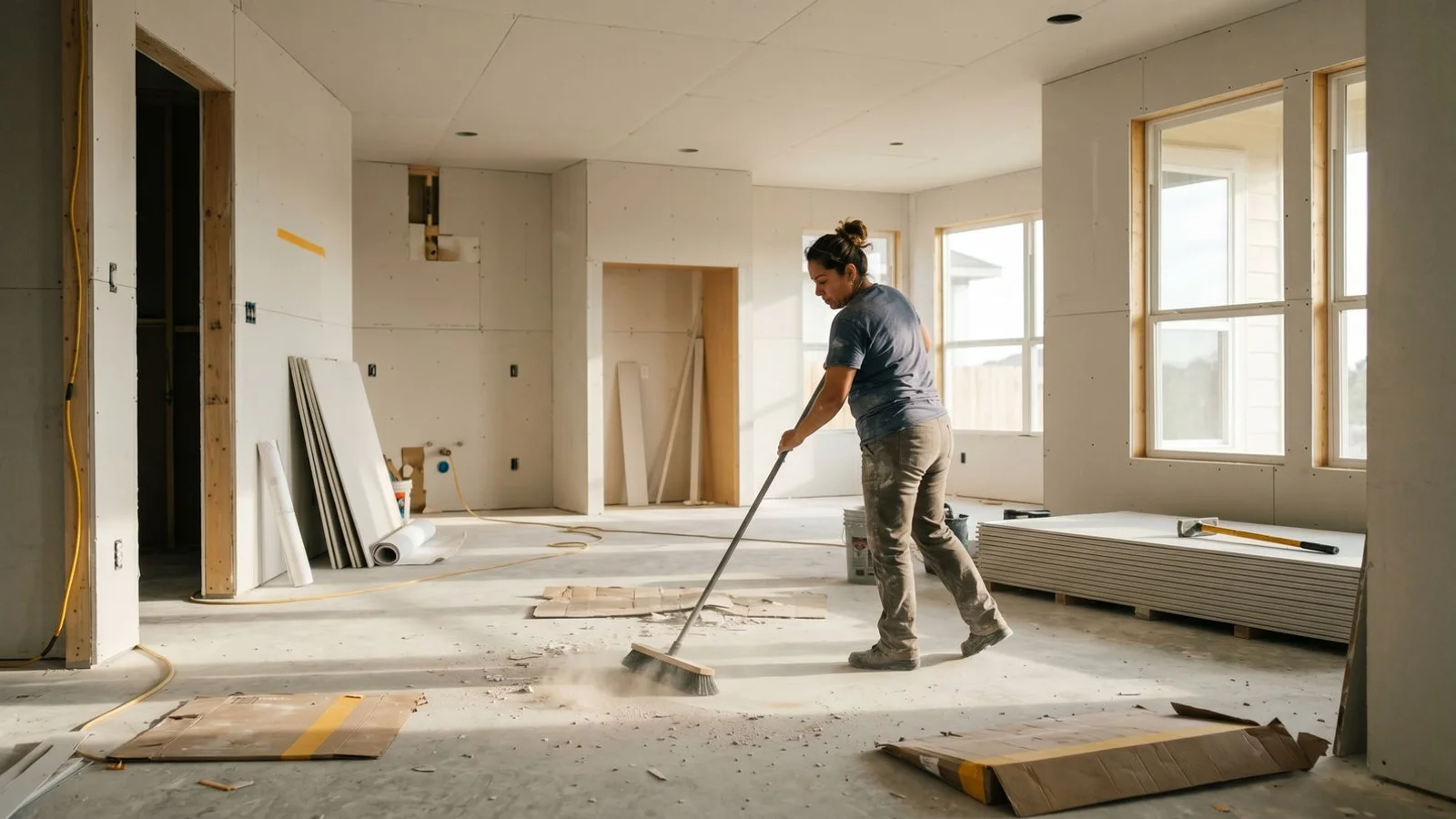
We notice a lot of confusion around the exact post construction cleaning scope.
This job actually bundles two distinct services under one name: the rough-clean, which happens between trade phases, and the final-clean right before handoff.
Our professional team at San Antonio Maid Services treats these as completely different operational stages.
Knowing which phase you need before requesting a quote will change your price meaningfully.
Let’s look at the data, what it actually tells us about timelines, and explore how to schedule your cleanup effectively.
This guide expands on what we cover in our full post-construction cleaning service; use it as the deep-dive companion to that page.
Rough-clean phase
Rough-clean happens between trade phases, typically post-drywall and pre-paint, or post-paint and pre-trim.
The main goal here is removing gross debris and fine dust so the next trade can work without contaminating their finish work.
Our crews follow the Occupational Safety and Health Administration (OSHA) 1926.1153 standard, which restricts dry sweeping of silica drywall dust.
Heavy-duty vacuums equipped with High-Efficiency Particulate Air (HEPA) filters are absolutely mandatory for this step to meet the 99.97% efficiency requirement.
We typically see 2026 national average rates for rough cleaning sitting between $0.10 to $0.30 per square foot.
This phase runs much faster and lighter than a final-clean, keeping your per-square-foot pricing on the lower end.
Standard construction cleanup tasks
- Sweep up construction debris (off-cuts, packaging, dust piles)
- HEPA vacuum floors and horizontal surfaces
- Wipe down surfaces that subsequent trades will work on (cabinets pre-paint, trim pre-stain)
- Remove tape residue and floor protection where appropriate
- General site tidy
Final-clean phase
Final-clean happens after all trades are out, right before move-in or handoff.
This is the deep, multi-pass clean that prepares the home for true occupancy.
Our experience shows that skipping the proper waiting period is a costly mistake.
The National Association of Home Builders recommends scheduling this step 24 to 48 hours after trades leave so airborne dust can fully settle.
We find that drywall dust resettles from elevated surfaces, like the tops of cabinets or vents, for hours after the initial cleanup.
A single pass leaves visible dust within a day.
Our standard protocol usually runs in two passes, sometimes three, depending on the severity of the site.
In 2026, a detailed final clean of this magnitude costs anywhere from $0.30 to $1.50 per square foot nationally.
Detailing the Upper Zones
- Multi-pass HEPA vacuum on every horizontal surface
- Window track interior cleaning (one of the most-missed surfaces)
- Light fixture and ceiling fan dusting and wipe-down
- HVAC vent and return cover cleaning (visible portions)
- Cabinet exterior detailed; interiors quick-pass for dust
Floor and Trim Detailing
- Trim, baseboards, door frames, and door tops detailed
- Paint over-spray removal (where safe to remove without damaging finish)
- Adhesive and caulk residue removal
- Glass cleaning (interior windows, mirrors, shower glass)
- Floor finishing: final sweep, mop, or vacuum depending on floor type
- Bathroom and kitchen fixture polishing
- Final walk-through inspection
Surfaces commonly missed
Post-construction cleaning fails most often on very specific surfaces.
Standard cleaners who lack specialized training routinely miss these critical zones.
Our review of recent 2026 home inspection data reveals that HVAC returns and window tracks are the top two areas failed during new build final walkthroughs.
This breakdown highlights the most problematic spots to watch during your inspection.
High and Hidden Dust Traps
Light fixtures and ceiling fan blades. Drywall dust settles on every horizontal surface, especially the ones above eye level.
Cabinet tops. Fully built cabinets often have dust on top from late-trade work after cabinet install.
Door frame tops. Never seen, always inspected.
Top of trim. Crown molding and door casing tops collect dust during dry-trade phases.
Mechanical and Installation Zones
Window tracks. Lower window tracks pack with fine plaster and silica dust during construction. The dust reappears the first time the window is opened.
HVAC vents and return covers. Visible portions of cold-air returns and supply vents accumulate construction dust. Ducts themselves are a separate licensed-trade job.
Behind appliances installed during construction. Refrigerators and dishwashers installed mid-build sometimes have dust collected during install.
Paint and adhesive residue
Removing stuck-on materials requires specific chemistry rather than brute force.
Scratching a brand-new window or damaging a custom finish is a massive liability.
Our technicians use specialized tools, like plastic razor blades, to lift residue off glass without leaving permanent scratches.
Industry-standard citrus solvents like Goo Gone Pro-Power or mineral-spirit-based Goof Off Pro Strength handle the stubborn spots.
We rely on these targeted treatments because knowing when to stop is just as important as knowing which chemical to apply.
Severe items in the “Do Not Attempt” category get flagged directly for the General Contractor (GC).
Our team knows that paint-trade rework is not a cleaning task.
Risky removals usually cause more harm than good.
Residue Treatment Guidelines
| Material Issue | Our Treatment Approach | What We Do Not Attempt |
|---|---|---|
| Paint over-spray | Solvent-free on tile, glass, and stainless steel; mineral-spirits for set paint. | Paint sitting for weeks that requires finish-damaging solvents. Substantial paint runs. |
| Adhesive residue | Citrus solvent or mineral spirits for floor protection tape. | Adhesives on porous surfaces where solvents soak in and ruin the material. |
| Caulk smears | Fresh caulk wiped away; set caulk requires a careful scrape. | Risky removal that might gouge the underlying brand-new surface. |
| Stickers and labels | Solvent application or a careful peel on appliances and windows. | N/A |
What is NOT included in the post construction cleaning scope
Setting clear boundaries prevents scheduling delays and unexpected bills at the end of the project.
Certain tasks require specialized licenses, specific insurance, or heavy equipment that standard cleaning crews do not carry.
Our contracts explicitly exclude these distinct trade specialties.
Budgeting separately for these common final-stage requirements is a smart move.
We recommend securing your waste management early, as US dumpster rentals average $300 to $500 in 2026 depending on your region.
A professional certified by the National Air Duct Cleaners Association (NADCA) must handle all HVAC duct cleaning.
Excluded Specialty Trades
- Debris haul-away. Requires a roll-off dumpster. We coordinate cleaning timing around your dumpster pickup but do not haul. This keeps your site running smoothly.
- HVAC duct cleaning. Licensed-trade specialty service. Our teams clean visible vents only. Ducts require specialized equipment.
- Drain cleaning. Plumbing trade.
- Concrete or masonry sealing. Trade-specific.
- Trade rework. If a trade left damage or unfinished work, that is between you and the trade contractor.
- Pest treatment. Separate trade.
- Pressure washing. Exterior trade.
Typical hours per square foot
Labor is the biggest variable in post-construction cleaning.
National labor shortages in 2026 have pushed average hourly rates for specialized cleaning crews to $45 to $75 per hour in the US.
Our estimates rely on a strict labor-hour calculation to give you an accurate picture of the final cost.
A “labor hour” represents one hour of continuous work by one person.
We always explain that if a task requires 10 labor hours, a team of two will finish it in five clock hours.
A 2,500 sq ft new build typically needs 60 to 100 labor hours of post-construction cleaning across both the rough and final phases.
Baseline Cleaning Estimates
| Cleaning Phase | Labor Hours Required |
|---|---|
| Rough-clean | 0.5 to 1 hour per 100 sq ft |
| Single-pass final-clean | 1 to 2 hours per 100 sq ft |
| Multi-pass final-clean | 2.5 to 4 hours per 100 sq ft |
Coordinating with your GC
Communication between the builder and the cleaning team keeps the project on schedule.
Builders and GCs running multiple sites often get recurring-project pricing from their cleaning partners.
Our scheduling team works directly around your specific construction timeline.
A few specific details help ensure a smooth transition.
Information to Share Upfront
- Trade schedule: When each trade is checking in and out.
- Dumpster pickup: The final debris haul timing.
- Move-in date: When the home needs to be absolutely ready.
- Specific high-trade-residue zones: Kitchens, bathrooms, and painting concentration areas.
For HEPA and microfiber technical detail, see construction dust removal, why HEPA and microfiber matter.
Our team also provides a comparison with regular maintenance services.
For a complete breakdown, see post-construction vs deep cleaning.
Get a project quote and share your square footage and trade schedule for accurate pricing.
Finalizing your post construction cleaning scope early ensures your project finishes on time and on budget.
Related service
Need Post-Construction in San Antonio?
Drywall dust, debris, and finish wipe-down for new builds and remodels. HEPA equipment for safe respiratory cleanup. Coordinate with your GC.